microsoft/git-base-vatex ↗
- source model id
- HuggingFace/microsoft-git-base-vatex@3
- hosting
- foundry-managed-compute
- platforms
- Microsoft Foundry
- license
- mit
- architecture
- input_modalities
- text
- output_modalities
- text
- capabilities
 Sign in
# GIT (GenerativeImage2Text), base-sized, fine-tuned on VATEX GIT (short for GenerativeImage2Text) model, base-sized version, fine-tuned on VATEX. It was introduced in the paper [GIT: A Generative Im…
azureFoundry/HuggingFace/microsoft-git-base-vatex@3
GIT (short for GenerativeImage2Text) model, base-sized version, fine-tuned on VATEX. It was introduced in the paper GIT: A Generative Image-to-text Transformer for Vision and Language by Wang et al. and first released in this repository.
Disclaimer: The team releasing GIT did not write a model card for this model so this model card has been written by the Hugging Face team.
GIT is a Transformer decoder conditioned on both CLIP image tokens and text tokens. The model is trained using "teacher forcing" on a lot of (image, text) pairs.
The goal for the model is simply to predict the next text token, giving the image tokens and previous text tokens.
The model has full access to (i.e. a bidirectional attention mask is used for) the image patch tokens, but only has access to the previous text tokens (i.e. a causal attention mask is used for the text tokens) when predicting the next text token.
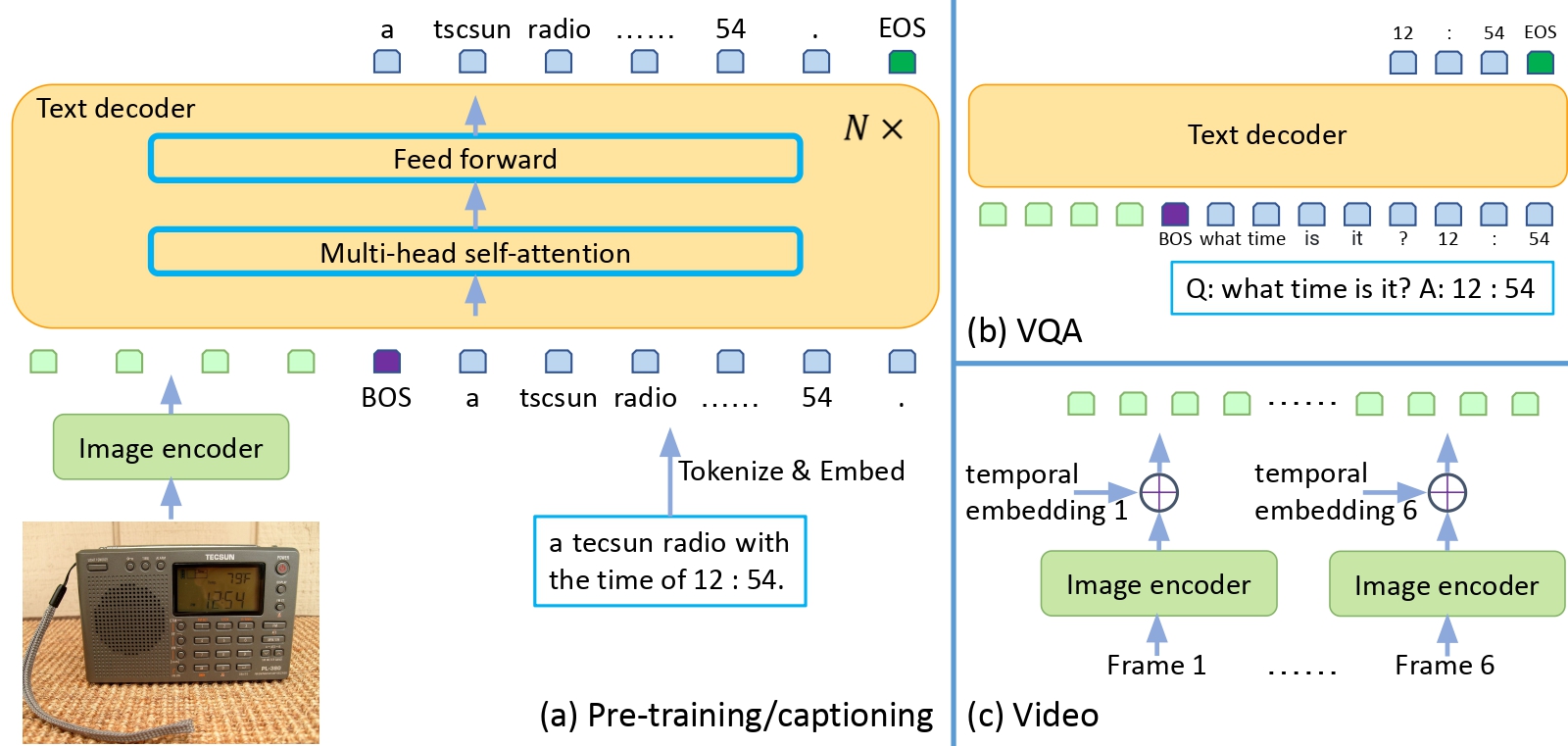
This allows the model to be used for tasks like:
You can use the raw model for video captioning. See the model hub to look for fine-tuned versions on a task that interests you.
For code examples, we refer to the documentation.
From the paper:
We collect 0.8B image-text pairs for pre-training, which include COCO (Lin et al., 2014), Conceptual Captions (CC3M) (Sharma et al., 2018), SBU (Ordonez et al., 2011), Visual Genome (VG) (Krishna et al., 2016), Conceptual Captions (CC12M) (Changpinyo et al., 2021), ALT200M (Hu et al., 2021a), and an extra 0.6B data following a similar collection procedure in Hu et al. (2021a).
=> however this is for the model referred to as "GIT" in the paper, which is not open-sourced.
This checkpoint is "GIT-base", which is a smaller variant of GIT trained on 10 million image-text pairs.
Next, the model was fine-tuned on VATEX.
See table 11 in the paper for more details.
We refer to the original repo regarding details for preprocessing during training.
During validation, one resizes the shorter edge of each image, after which center cropping is performed to a fixed-size resolution. Next, frames are normalized across the RGB channels with the ImageNet mean and standard deviation.
For evaluation results, we refer readers to the paper.
microsoft/git-base-vatex is a pre-trained language model available on the Hugging Face Hub. It's specifically designed for the text-generation task in the transformers library. If you want to learn more about the model's architecture, hyperparameters, limitations, and biases, you can find this information on the model's dedicated Model Card on the Hugging Face Hub.
Here's an example API request payload that you can use to obtain predictions from the model:
{
  "inputs": "My name is Julien and I like to"
}
1–1 / 1
1–4 / 4
Hugging Face · microsoft/git-base-vatex ↗
Microsoft Foundry · Model page ↗
1–1 / 1
These charts contain model-linked results. The charts above also include unlinked source profiles. Compare scores within each evaluation. Model quality, usage, transparency and system performance measure different things.